Norwood Scale and Shock Loss: What the Stages Mean for Your Recovery Timeline
How your Norwood stage affects shock loss timing and graft survival expectations after transplant.
Read article
Design hairlines with Golden Ratio facial analysis and simulate up to 50,000 strands for consultation-ready previews. Built for patients and clinics who want a clearer plan before surgery.

HairArchitect AI helps patients and clinics align on hairline shape, density, and graft scale before surgery—using on-device rendering and proportion-based starting points.
Computer vision maps facial landmarks and suggests proportional hairline starting points—refined by your surgeon for age, ethnicity, and donor limits.

On-device rendering previews up to 50,000 strands for consult discussions. Previews illustrate planning intent—not guaranteed surgical outcomes.
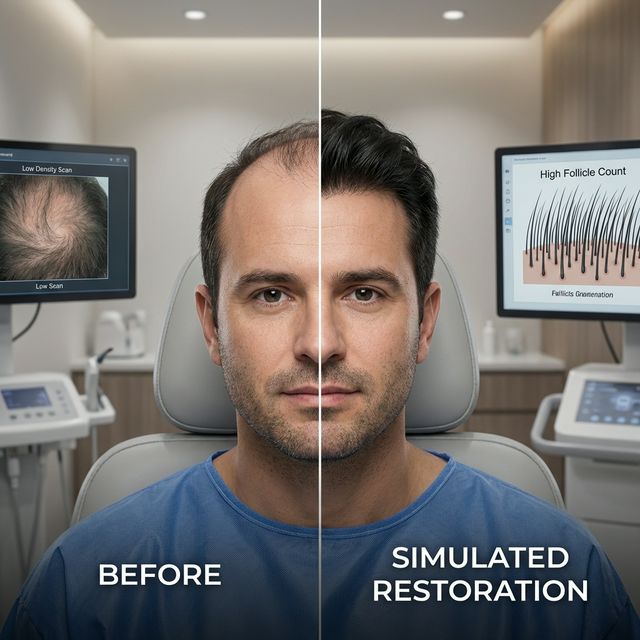
Local rendering for real-time design sessions, with optional cloud-enhanced previews. Built for consult clarity, not diagnosis.
Precision tools for surgeons including Smart Multi-Point Designers, Paint-Masking for custom zones, and Curvature Correction for natural results.

Feedback from patients and clinicians who used HairArchitect AI during planning.
"The preview looked close enough to my hair texture that I finally understood what the surgeon was proposing."
"Golden Ratio gave us a starting line; my doctor adjusted the temples and we agreed on the plan together."
"Seeing density on the hairline—not just a drawn curve—helped me ask better questions in consult."
"Our clinic uses it on the iPad during consults. Patients engage more when they see their own photo."
"I still needed my surgeon's sign-off, but walking in with a draft hairline made the conversation shorter."
"Useful for aligning expectations. We treat outputs as planning aids, not promises about growth."
"Helped me picture coverage at the hairline. Recovery was its own story—this was about the plan."
"Fast enough to iterate during a single visit. We tried two densities before booking."
"The heatmap view made it obvious where we were packing grafts versus leaving native hair."
"Straightforward export for the coordinator. Less back-and-forth on WhatsApp."
"The preview looked close enough to my hair texture that I finally understood what the surgeon was proposing."
"Golden Ratio gave us a starting line; my doctor adjusted the temples and we agreed on the plan together."
"Seeing density on the hairline—not just a drawn curve—helped me ask better questions in consult."
"Our clinic uses it on the iPad during consults. Patients engage more when they see their own photo."
"I still needed my surgeon's sign-off, but walking in with a draft hairline made the conversation shorter."
"Useful for aligning expectations. We treat outputs as planning aids, not promises about growth."
"Helped me picture coverage at the hairline. Recovery was its own story—this was about the plan."
"Fast enough to iterate during a single visit. We tried two densities before booking."
"The heatmap view made it obvious where we were packing grafts versus leaving native hair."
"Straightforward export for the coordinator. Less back-and-forth on WhatsApp."
Use HairArchitect AI to draft a visual plan, then confirm every number and design choice with a licensed hair restoration surgeon.
Planning tool · Privacy-first · GDPR/KVKK aligned · Not a medical device
We use it to walk patients through the plan before surgery. Seeing the hairline on their own face cuts down on guesswork in the consult room.
HairArchitect AI is a planning app for hair transplant consults. It maps facial landmarks, previews hairline density on your photo, and estimates graft ranges. Surgeons still make the surgical decisions.
It finds facial landmarks and suggests where a hairline might start. That is a starting sketch. Your surgeon still adjusts for age, hair type, and how much donor hair you have.
Most of the preview runs on your phone. Cloud previews are optional. Treat every preview as a planning sketch, not a photo of your future result.
It multiplies area by target density, then caps the number against a safe donor yield. Bring those numbers to clinic—your surgeon owns the final count.
No. It helps with planning and pictures. It does not diagnose hair loss or replace an exam.
Photos are used for the features you turn on. Retention and rights are in the Privacy Policy: https://www.hairarchitect.app/en/privacy.
Yes. You can draw a hairline on your photo and preview density for the consult. It is a discussion tool—not a guarantee.
It depends on how large the thin area is, target density, hair thickness, and donor supply. Run a calculator, then confirm in person.
Norwood stages male pattern loss from I to VII. Clinics use it to talk about how much scalp needs coverage.
Short reads on planning, simulation, and consultation communication.
How your Norwood stage affects shock loss timing and graft survival expectations after transplant.
Norwood I–VII stages male pattern baldness. Staging guides hairline design and graft planning, but donor supply and hair thickness still drive the final plan. L
Clinical factors that decide how many grafts can be safely harvested beyond simple density numbers.
Planning glossary
Short definitions for grafts, techniques, and hairline design—linked to our full glossary and blog.